
Why Can't My AI Search Everything Across My Organization?
Updated: Sep 22
One of the most common surprises organizations encounter after deploying an enterprise AI platform is discovering that the AI doesn't automatically understand everything across the company. The assumption is understandable:
If all of our systems belong to the same organization, shouldn't the AI be able to search across all of them?
Short Answer
Generally, no. Most enterprise AI interfaces—including Atlassian Rovo, Microsoft 365 Copilot, Google Gemini Enterprise, Gemini for Workspace, and Salesforce Agentforce—respect the boundaries of the systems, tenants, workspaces, sites, connectors, and permissions they are configured to access. While vendors continue expanding connectors, enterprise search, and interoperability, there is rarely a native "search everything everywhere" experience.
Why This Feels Confusing
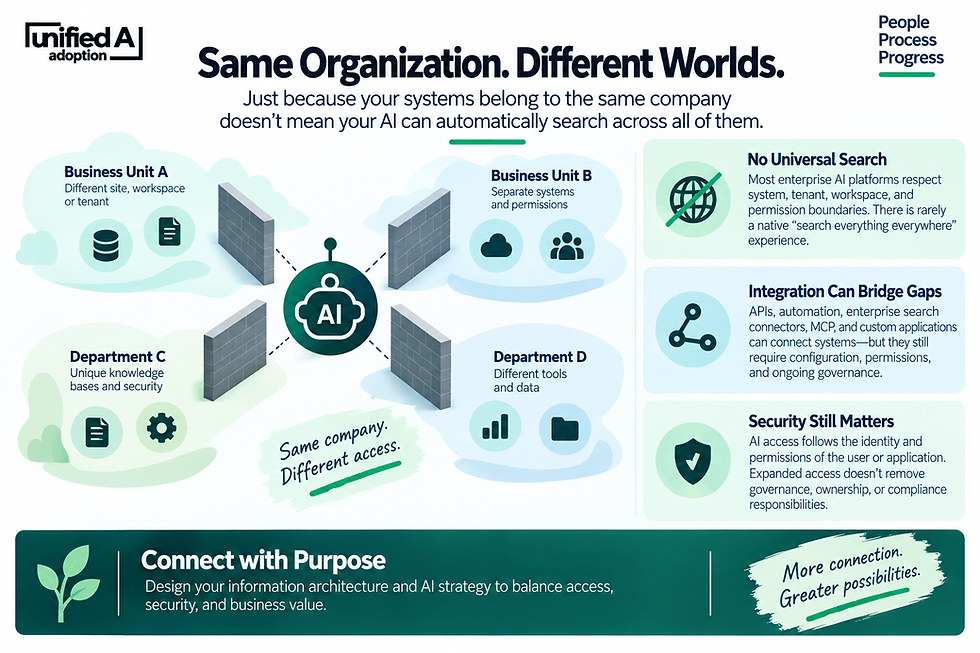
Part of the confusion comes from how enterprise platforms are organized. Many organizations have:
Multiple business units
Separate cloud sites or tenants
Independent workspaces
Department-specific knowledge bases
Different security boundaries
To users, it often feels like one company. To the AI, those environments may be separate worlds. Even within a single vendor's ecosystem, some locations may be searchable while others are not, depending on configuration, licensing, rollout status, permissions, or architectural boundaries. The result is an AI experience that can feel fragmented, even though the underlying systems belong to the same organization.
The Real Enterprise Challenge
The discussion quickly moves beyond search. Organizations increasingly want AI to:
Search knowledge across departments
Create content in multiple workspaces
Connect business processes that span different systems
Act across organizational boundaries
This isn't unique to one platform. Whether you're using Atlassian Rovo, Microsoft 365 Copilot, Google Gemini, Salesforce Agentforce, or another enterprise AI interface, customers increasingly expect AI to understand work regardless of where that information lives. In practice, organizations often approximate this experience by using:
APIs
Workflow automation
Integration platforms
Enterprise search connectors
Data synchronization
Model Context Protocol (MCP)
These approaches can bridge some gaps, but they don't create a truly unified AI experience.
Can MCP Solve This?
Model Context Protocol (MCP) is becoming an increasingly popular way to connect external AI interfaces with enterprise systems. Rather than copying data into every AI platform, MCP provides a standardized way for AI assistants to request information and perform approved actions. That makes it a powerful integration layer. However, MCP is not a universal solution. Most MCP servers execute actions using the identity and permissions of the authenticated user or application. That means:
Actions respect existing permissions.
Access is governed by identity.
MCP does not automatically create a shared organizational identity or permission model that spans every system.
In other words, MCP helps AI reach more systems, but it doesn't eliminate governance, ownership, or security considerations.
What About Custom Applications?
Another option is building custom integrations. Many enterprise platforms provide application frameworks that allow organizations to create solutions tailored to their environment. These applications can:
Read information from one system
Update another
Coordinate workflows across platforms
Bridge otherwise disconnected environments
This approach provides much greater flexibility, but it also introduces responsibilities.
Organizations must still:
Design the integration
Manage permissions
Review security
Maintain the application
Handle differences between systems
Custom applications can solve many interoperability challenges, but they remain custom solutions rather than native platform capabilities.
What This Tells Us
Whether the platform is Atlassian Rovo, Microsoft 365 Copilot, Google Gemini, Salesforce Agentforce, or another enterprise AI interface, customers are increasingly trying to solve the same problem. They don't want separate AI experiences for separate systems. They want AI to understand their knowledge, workflows, and business processes regardless of where the information happens to live.
Today, APIs, automation, custom applications, enterprise search, and MCP can bridge many of those gaps. But they are still workarounds for a capability many organizations increasingly expect AI platforms to provide natively.
Use this Prompt: Act as an enterprise AI search architect. Review this environment: [describe the AI platform, systems, tenants, sites, workspaces, connectors, data sources, and user groups]. Identify where AI search or agent behavior may be limited by system boundaries, tenant or site configuration, permissions, indexing, connector availability, MCP setup, or execution identity. Return the answer as a table with: system or workspace, what users expect AI to find or do, likely boundary or limitation, connector or integration option, governance concern, and test needed before rollout.


Comments