
What Does Unified AI Adoption Mean?
Updated: Sep 22
As AI becomes embedded in everyday work, many organizations are realizing something important: AI adoption does not usually fail because of technology alone. It often stalls because adoption is fragmented.
Teams adopt tools in isolation. Individuals experiment without shared understanding. Leaders invest in platforms without aligning behaviors, skills, or governance. The result is uneven usage, mistrust, duplicated effort, and stalled momentum.
Unified AI Adoption exists to solve that problem.

Unified AI Adoption: More Than a Platform Strategy
When people talk about “unified AI,” they often mean consolidating tools or selecting a single AI platform. While platform alignment matters, that framing is too narrow for how AI actually shows up in modern organizations.
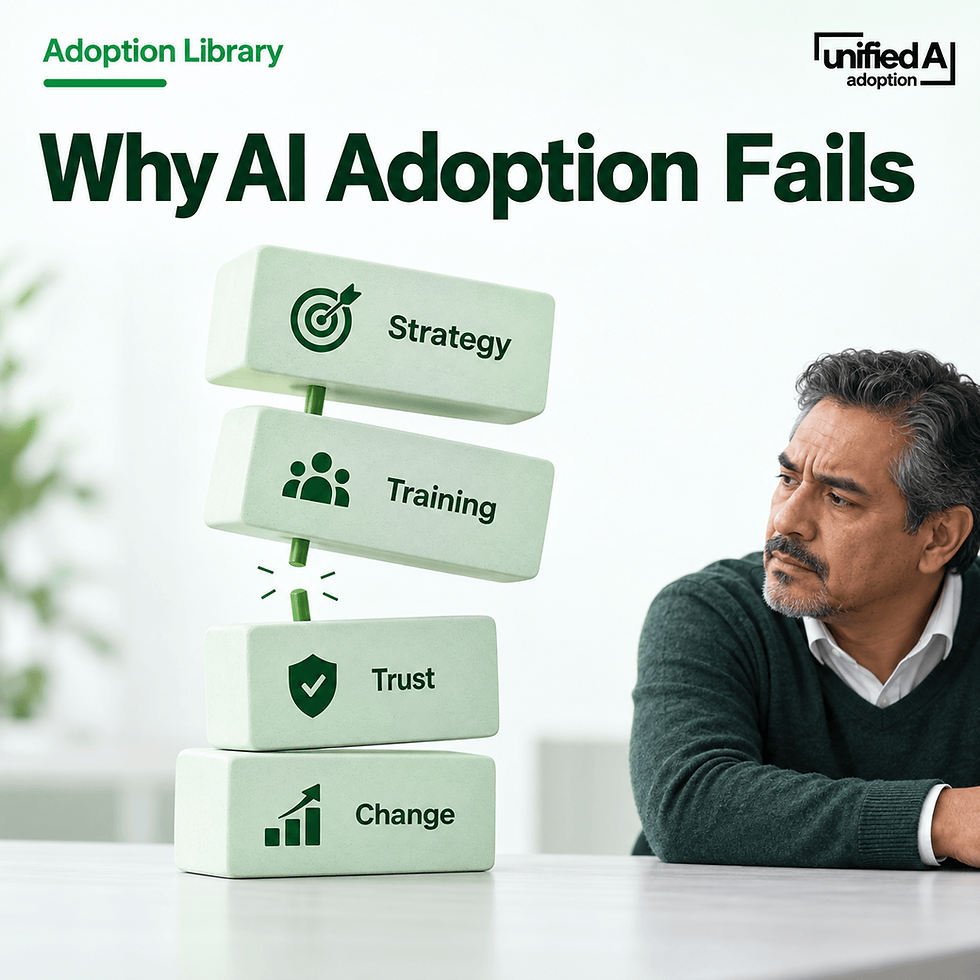
AI adoption rarely succeeds on the tool alone. It fails because tools, problems, people, and systems are not aligned.
At Unified AI Adoption, we define it differently:
Unified AI Adoption is the intentional alignment of AI tools, personal AI use, and organization-wide AI practices—so individuals, teams, and systems can learn, adapt, and scale together across an evolving ecosystem of AI capabilities.
This means unifying:
The problems AI is meant to solve with the tools selected to solve them
Individual AI understanding and habits
Team-level workflows and shared practices
Organization-wide governance, measurement, and accountability
An ecosystem of multiple AI systems working together in real work
Without this alignment, even well-funded AI investments struggle to deliver value.
Adoption Gaps Organizations Commonly Overlook
1. Tool–Problem Gap
Many organizations adopt AI tools before clearly defining the problems they are meant to address. This leads to:
impressive demos with limited impact
tools searching for use cases
fragmented experimentation
low sustained adoption
Unified AI Adoption starts by grounding AI choices in real operational needs, not novelty.
2. Ecosystem Gap
Most organizations don’t use one AI—they use many:
embedded AI in enterprise platforms
standalone assistants
vendor-specific automation
experimental tools used by individuals
When these systems are treated in isolation, teams lose visibility, consistency, and trust. Unified AI Adoption acknowledges AI as an ecosystem, not a single product decision.
3. Personal Adoption Gap
Most people encounter AI individually first—through chat tools, writing assistants, or small automation experiments. This creates:
uneven confidence levels
inconsistent mental models
quiet workarounds
fear, overreliance, or misuse
Organizations often overlook this layer, even though it shapes how every formal rollout is received.
4. Organizational Adoption Gap
At the same time, organizations deploy AI through:
platforms
pilots
policies
enablement programs
When these efforts don’t reflect how people are already using—or struggling with—AI, adoption stalls. Not because of resistance, but because of misalignment.
How Unified AI Adoption Connects These Gaps
Unified AI Adoption doesn’t force a choice between tools or people, platforms or behavior. It is not:
a single tool
a one-time rollout
a training-only initiative
a governance-only initiative
It is a continuous adoption system that connects people, platforms, and processes.
It connects:
tools to problems
personal understanding to organizational intent
individual experimentation to shared practice
multiple AI systems into a coherent operating model
This is how AI becomes usable, governable, and scalable—without slowing innovation or overwhelming teams.
It focuses on:
shared language
progressive skill-building
practical use cases
visible governance
measurable outcomes
And it recognizes that adoption maturity grows in stages, not all at once.
The Core Principles of Unified AI Adoption
1. Start With Understanding, Not Automation
Before asking “What can AI do?”, unified adoption asks:
What do people believe AI is?
Where are they confused or uncertain?
Where are they already experimenting on their own?
Adoption moves faster when understanding is aligned first—before tools or automation enter the conversation.
2. Align Individual Capability With Organizational Intent
People don’t adopt what they don’t understand—or what feels disconnected from their role. Unified AI Adoption ensures:
individuals know how AI supports their daily work
teams share patterns instead of reinventing them
leaders communicate clear direction and expectations
This alignment reduces shadow usage and uneven outcomes across teams.
3. Treat AI as a Change Initiative, Not a Feature
AI reshapes how work gets done, how decisions are made, and how accountability is shared. Unified adoption integrates:
documentation
training
process design
change management
This ensures AI becomes part of normal operations—not a side experiment that fades after launch.
4. Govern What Matters Across the AI Ecosystem
Unified AI Adoption doesn’t try to control every tool or interaction. Instead, it focuses governance where risk, impact, and dependency are highest—especially in environments with multiple AI systems in play. That includes:
clarity on high-impact use cases
transparency around data sources and decision points
human oversight where judgment and responsibility matter
Governance works best when it reflects how AI is actually used across an ecosystem, not how it appears on an org chart.
5. Design Learning at Every Level
Unified AI Adoption assumes:
tools will change
capabilities will evolve
policies will mature over time
Rather than treating learning as a one-time event, it builds learning into the system itself—through enablement agents, shared practices, ongoing documentation, and continuous feedback loops. This is what allows both individuals and organizations to adapt together as the AI ecosystem grows.
Why Unified AI Adoption Is Becoming Essential
As AI becomes embedded across:
productivity tools
enterprise platforms
customer-facing systems
operational workflows
The cost of fragmented adoption grows.
Organizations without a unified approach face:
inconsistent outcomes
governance blind spots
employee mistrust
slower ROI
regulatory exposure
Unified AI Adoption creates coherence in a rapidly shifting environment.
What Unified AI Adoption Looks Like in Practice
In organizations applying this approach, you’ll see:
shared AI language across roles
documented use cases tied to outcomes
training aligned to real workflows
clear escalation paths for AI-related issues
leaders and practitioners learning together
AI stops being “someone else’s responsibility” and becomes a collective capability.
Moving Forward With Intention
Unified AI Adoption isn’t about moving faster at all costs. It’s about moving together, with clarity and purpose. Whether you’re:
just starting to explore AI
scaling pilots across teams
preparing for regulatory scrutiny
or trying to reset stalled adoption
A unified approach ensures your people and systems evolve in step.
Ready to explore what unified AI adoption looks like in your organization?
We help teams assess where adoption is fragmented, align personal and organizational readiness, and build practical paths forward—grounded in real work, not hype. Sometimes the most powerful AI strategy isn’t adding another tool. It’s unifying how people understand and use the ones they already have.


Comments